Tour du Mont Blanc
Three countries, 10 000m of climbing, and the most famous mountain in the Alps
Distance
106 mi / 170 km
Elevation
32,808 ft / 10,000 m
Duration
2–8 days
Difficulty
Extreme
Best Season
June – September
Route Map
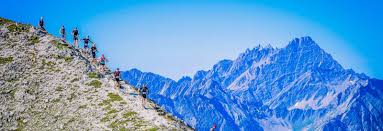
The Tour du Mont Blanc is the most walked long-distance alpine trail in the world. The 170km circuit around the highest mountain in Western Europe passes through three countries, crosses 10 significant passes, and offers uninterrupted views of the 4808m summit from every angle. Walking it at a standard pace takes 10-14 days. Running it at an athletic pace takes 3-6 days. Each is a different relationship with the same mountain.
The trail begins and typically starts in Chamonix, though there is no official starting point for the circuit. The route runs counterclockwise through the Vallée de Montjoie in France, crosses the Grand Col Ferret at 2537m into Italy at La Palud, traverses the Val d'Aoste through Courmayeur, crosses the Grand Col Ferret into Switzerland, traverses the Valais through Champex-Lac and Trient, and returns to Chamonix over the Balme and Forclaz passes.
The infrastructure is exceptional. Refuges and auberges are spaced every 15-20km on the standard route, and the population of Chamonix-valley infrastructure means resupply on any section is manageable. For runners, this means carrying minimal weight — a day's food, emergency gear, and a light layer is sufficient if refuge accommodation is accepted.
The terrain is consistently demanding. The passes are not technical but they are sustained — the Grand Col Ferret gains 750m in 3km from the Courmayeur side, which is a climbing rate that requires pacing at altitude regardless of the excellent surface. The Les Houches section above Chamonix is the most technical: narrow singletrack on exposed slopes above the Arve valley with significant drop-offs on the outer edge.
Weather determines everything. The Mont Blanc massif generates its own microclimate — afternoon cloud builds on the summit by noon in summer, and electrical storms can develop within an hour of clear blue sky. All ridge and pass crossings should be timed for morning. Do not be on the Grand Col Ferret in a lightning storm.
Most runners take 4-6 days on the full circuit. The UTMB race covers the same route in under 20 hours at the elite level — the comparative scale is useful context for planning your own schedule.
Route Details
External Resources
Gear
Trail shoes with good grip on wet alpine terrain
Shoes
Waterproof jacket — alpine afternoon storms
Clothing
Warm base layer — passes above 2500m in morning
Clothing
Poles recommended for pass descents
Safety
Hut reservation (August is very busy)
Sleep
Water filter for off-hut sections
Water
They Did It
Videos, race reports & photos from athletes who completed this challenge.
Community Ratings
No ratings yet — be the first!
Related Challenges

Copper Canyon Traverse
🇲🇽Mexico
The Copper Canyon system (Barrancas del Cobre) is a network of six canyons deeper and wider than the Grand Canyon. A rim-to-river traverse through Tarahumara territory covers 290km with 15,000m up and 17,000m down.
Distance
180 mi / 290 km
Sport
Trail Running
Tour des Écrins
🇫🇷France
A 170km trail circuit around the Écrins massif in the French Alps, crossing high passes above 2800m through one of the most glaciated ranges in France.
Distance
106 mi / 170 km
Sport
Trail Running

Rinjani to Agung Traverse
🇮🇩Indonesia
A crossing from Gunung Rinjani (3,726m) in Lombok to Gunung Agung (3,142m) in Bali via traditional trails, a sea crossing, and the forests between the peaks. Short in kilometers, serious in everything else.
Distance
121 mi / 195 km
Sport
Trail Running